Chicken gear
that isn’t ugly.
Every waterer sold for a coop is the same scuffed red plastic. We go the other way: we find a piece of old ceramic that was one missing lid away from a dumpster — weight, glaze, lettering pressed into the clay — and fit it by hand to water or feed your birds better than the plastic ever did. One vessel, one piece, one owner. Found, never ordered from a catalogue.
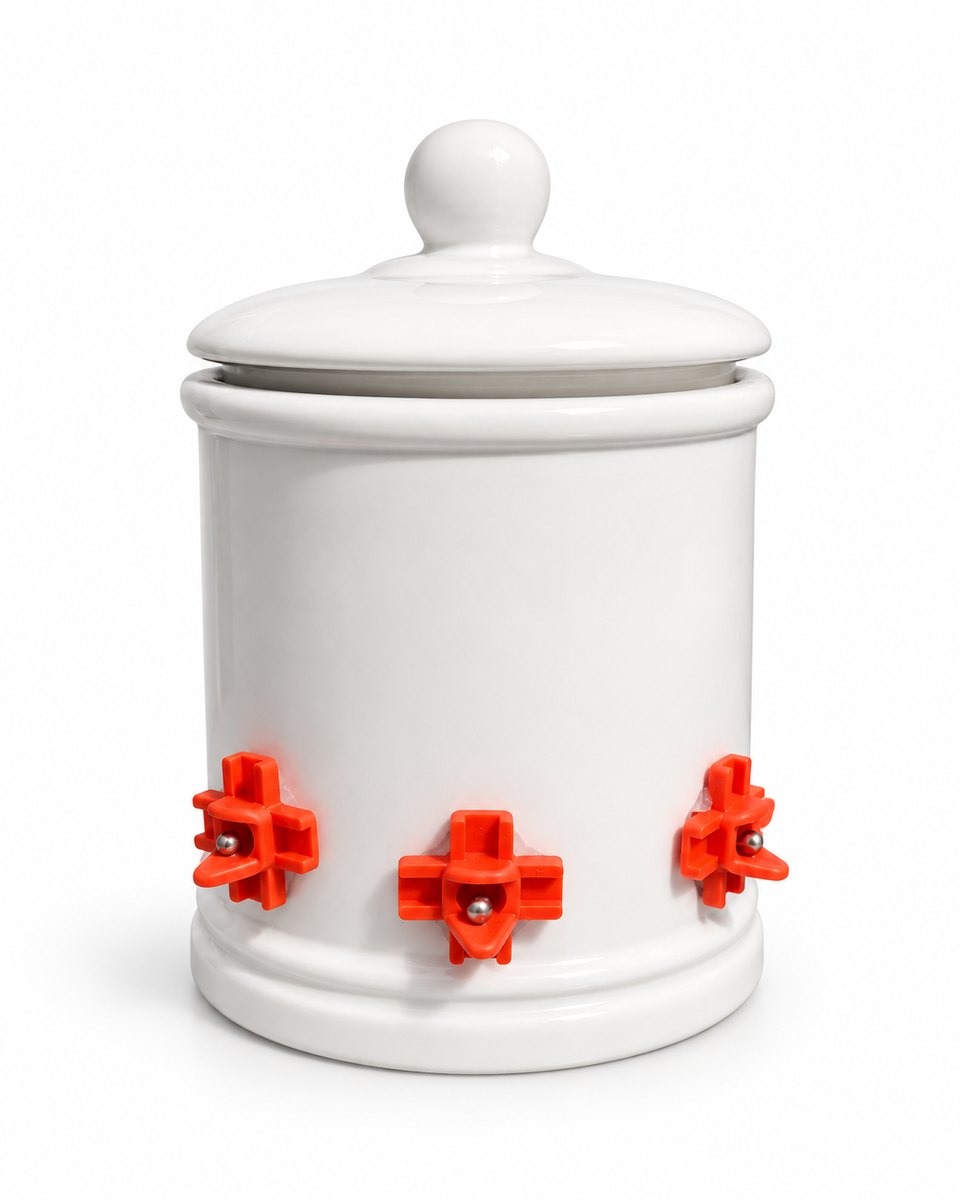
No. 2 Dry Goods Waterer
Thrifted ceramic canister · three horizontal nipples · 5.9″ across, 8.5″ tall · 1.2 quarts
Nobody needs another red plastic thing.
Every waterer in every feed store is the same waterer. Stamped out by the ten thousand, the colour of a traffic cone, built cheap enough that you’ll buy the next one. They work, more or less. They are also the ugliest object in your yard, and it’s the first thing you look at every morning.
Meanwhile there is a better object sitting in a thrift aisle for four dollars. A stoneware crock with the glaze still perfect. A dry-goods canister with the lettering pressed into the clay by somebody who assumed it would outlive them. An amber apothecary jar, a lidless biscuit barrel, a piece of depression glass nobody recognised. These were made when things were made — and most of them are one missing lid away from a dumpster. That is not a sad fact. That is the whole opportunity.
So that’s the trade: we find the piece nobody else clocked, and then spend an afternoon with a wet diamond bit and a steady hand turning it into the best waterer your birds will ever drink out of — or the feeder they eat from. Not an ornament that happens to hold water. A working fount that happens to be the nicest thing in the run.
Not a limited run. A run of one.
There is exactly one of each piece we make, because there was exactly one of the vessel we found. No second colourway, no restock, no “one of fifty.” When yours turns up, nobody else on earth has it — and nobody can knock it off, not because it’s protected but because the original is already gone.
Which is the reciprocity, really. We want to make these and then see them standing in somebody else’s run. You want one object out there that wasn’t dialled up on a heat press by the pallet. Both of those are real wants, and this is where they meet.
One person, in San Diego, who gives a shit.
A former runway model who worked in more than sixty countries and spent years on depression glass and antique ceramics — which sounds like a detour until you need someone who can tell, across a thrift store, that the crock on the bottom shelf is worth carrying home. That is the actual skill. The drilling can be taught. The eye is the job.
He’s autistic, and the mashup is the whole point rather than a quirk on the side. The work owes a lot to Roberto Lugo, who takes the most classical form in ceramics and puts the wrong thing on it on purpose, and somehow ends up truer than either half was alone. A No. 2 DRY GOODS canister that now holds nothing but water is that same joke told out loud in a chicken run — the vessel built to keep damp out, working for a living letting it through, one bird at a time.
Found, not manufactured
This began as a shop-shelf canister — heavy white ceramic, No. 2 raised on one face, DRY GOODS around the foot. It was never going to hold flour again. It is a better object than anything sold to keep birds in water, so it was made into one.
Three nipples are set into the wall by hand. Ceramic is drilled wet, with a diamond bit, slowly — the only way it takes a clean hole instead of a crack. Each nipple is seated on a food-safe gasket and sealed with aquarium-grade silicone, the kind rated to live underwater with fish, inside and out. Then it is filled and left standing for a week, because nothing leaves here until it has proved it doesn’t weep.
It is an afternoon of work with a hose, a slow bit and a steady hand — which is the part you are actually buying. The canister was the easy bit to find.
Why it works better than a fount
The water never sits open. Birds tap the pin and it comes to them, so shavings, droppings and sunlight never reach the supply — and what doesn’t see sun doesn’t grow algae. The nipples are the horizontal kind, which don’t drip the way downward pins do, so the bedding underneath stays dry. The lid lifts off to refill. Nothing to tip over, nothing to scrub green.
How long will it last your birds?
The No. 2 holds 1,100 ml — 1.2 quarts, 37 fl oz. Tap in your flock and the jug below is graduated in days for those exact birds.
- Standard laying henRhode Island Red, Australorp, Leghorn · 225 ml/day0 Standard laying hen
- Large / heavy henOrpington, Brahma, Jersey Giant · 300 ml/day0 Large / heavy hen
- BantamSilkie, Pekin, Dutch · 120 ml/day0 Bantam
- Coturnix quailstandard — brown, tuxedo, English white · 70 ml/day6 Coturnix quail
- Coturnix quail, jumbothe big meat lines · 110 ml/day0 Coturnix quail, jumbo
No ducks on this list, on purpose. A duck can't use this as its only water. Ducks flush their nostrils and eyes by dunking their whole bill, and trials that gave Pekin ducks nipple drinkers alone came back with blocked nostrils and worse gait scores. Ducks need open water they can get their face into.
about 3 days — top it up every other day.
6 birds drink about 420 ml a day between them.
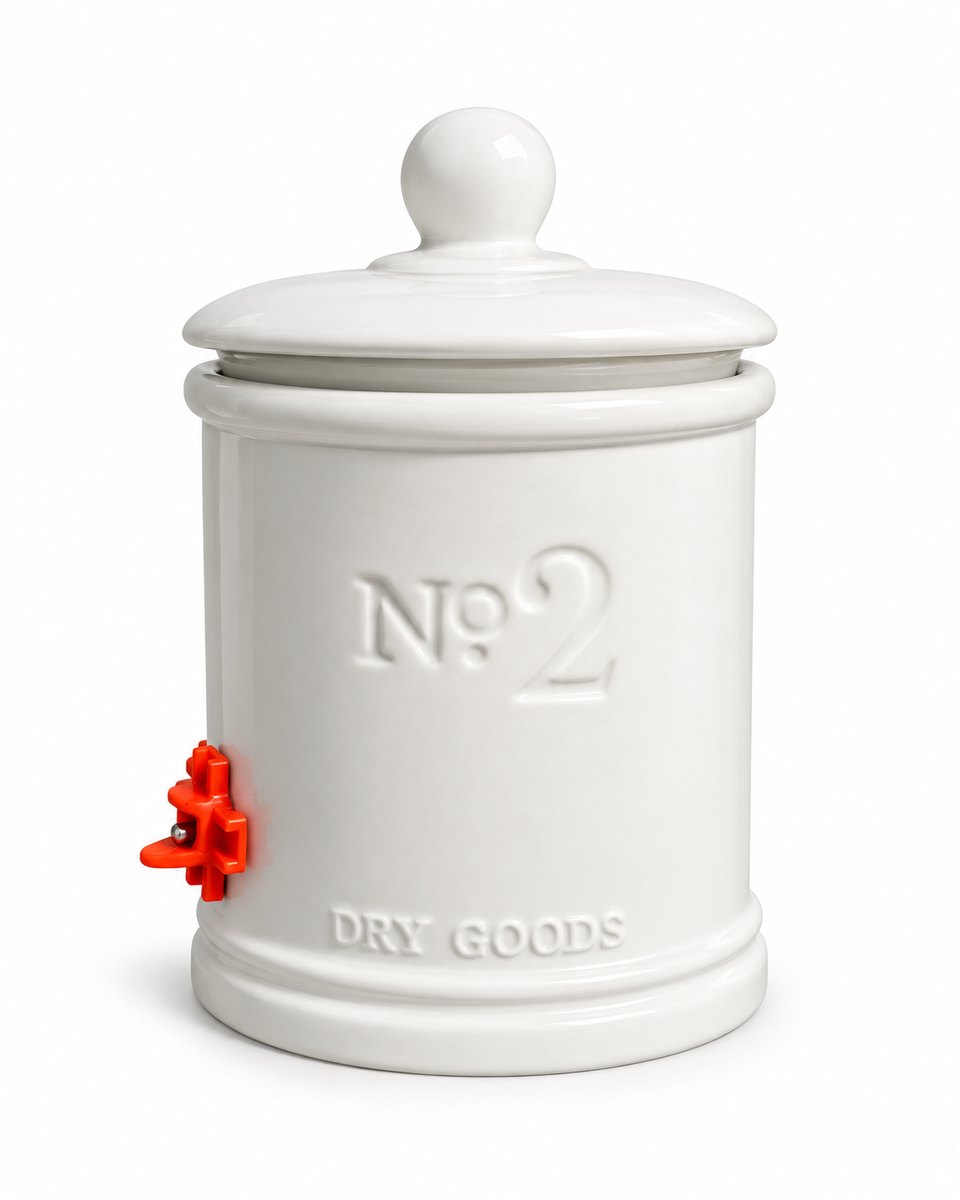
Built for the window
This piece was measured to sit inside our white flagship prototype coop, and the nipples set so that No. 2 Dry Goods reads straight through the window. That is the whole idea behind these: the equipment is part of how the coop looks, not something to be hidden behind it.
Choosing is the work. Before this was a farm, there was a career in fashion — runway for some of the most exclusive houses in the world, sixty-odd countries, years spent in rooms belonging to people who collect things properly. Depression glass, old ceramics, the difference between a shape that was designed and a shape that was merely tooled.
So a vessel is never picked only for its shape. This one is a canister that says DRY GOODS and now holds water, set so the lettering reads out through the coop window. The joke, the placement and the object were chosen together. That is the part that takes an eye, and it is most of what you are paying for.
They come off thrift shelves one at a time, never a catalogue. Nobody sees this in your run and orders the same one on Tuesday.
How it’s made
- 1. The vessel is found — secondhand, chosen for its weight, its shape and its lettering.
- 2. It is drilled wet, with a diamond bit, slowly. Ceramic gives you one attempt.
- 3. The nipples are seated on food-safe gaskets and sealed, inside and out.
- 4. It is filled and watched for a week before it is allowed to be sold.
Before you buy
- · 5.9″ across, 8.5″ tall with the lid on, holding 1,100 ml — 1.2 US quarts, 37 fl oz. Measured, not estimated.
- · It is a small-flock vessel. Six coturnix drink it down in about three days; two big hens empty it in under two. Work out your own birds above before you buy, and if the answer is “daily”, buy it because it’s beautiful, not because it’s the main waterer.
- · Sold as is, one of one. Secondhand vessel — it carries its own small marks.
- · Don’t let it freeze full. Ceramic full of water cracks in a hard freeze. Fine in San Diego, worth knowing elsewhere.
- · Hand wash. Refill through the top; the lid lifts off. Sealed with aquarium-grade silicone — safe for the birds, not for a dishwasher.
- · Shipping $25 anywhere in the US, double-boxed. Local pickup is free — it’s heavy, and we’d rather hand it to you.
Questions
- How much water does a chicken drink in a day?
- About 225 ml a day for a standard laying hen in mild weather — the University of Kentucky measures 210 ml and Kansas State 238, so call it a quarter litre. A heavy breed like an Orpington is nearer 300 ml, a bantam about 120. A coturnix quail, which people usually guess far too low, is around 70 ml while she's laying; that figure comes from Marzoni's 2014 measurements, one of the only real drinking studies on the species. In genuine heat all of these roughly double — Kentucky's paired figures run 210 ml at 68°F against 400 ml at 89.6°F. The calculator above does the arithmetic for whatever mix of birds you actually keep.
- How long does this waterer last?
- It holds 1,100 ml — 1.2 US quarts. That is about three days for six coturnix quail, about five days for a single standard hen, about two days for a dozen chicks in a brooder, and under two days for a pair of large hens. It is a small-flock and brooder vessel, not the main waterer for a run of laying hens. The calculator on this page will tell you honestly, including when the answer is that you want something bigger.
- Can ducks use a nipple waterer?
- Not as their only water source. A duck clears its nostrils and eyes by dunking its whole bill, and trials that gave Pekin ducks nipple drinkers alone reported blocked, dirty nostrils and worse gait scores than ducks given troughs or baths. Ducks need open water they can get their face into. This waterer is for chickens, quail and game birds.
- Do chickens actually learn to drink from nipples?
- Yes, usually within an hour. Tap the pin so a bead of water forms and dip two or three beaks; the rest of the flock copies them. Chicks learn just as fast as grown birds.
- Why is a nipple waterer better than an open fount?
- The water never sits open, so shavings, droppings and sunlight never reach it. No sun on standing water means no algae, which is the reason open founts need scrubbing. Horizontal nipples also don't drip the way downward-pin ones do, so the bedding underneath stays dry. There's a quieter benefit too: most of what passes between birds in a mixed flock is fecal-oral, and a vessel nothing can perch over, defecate into or kick litter into simply isn't that route. Worth being precise, though — sealed water is lower risk, not no risk. Coryza, for one, does still travel in drinking water.
- How do you drill ceramic without cracking it?
- Wet, with a diamond bit, slowly and with light pressure, backing the far side so it doesn't blow out on exit. Ceramic gives you one attempt. Never drill tempered glass — it shatters rather than chips.
- Is it safe for the birds?
- The nipples sit on food-safe gaskets and are sealed with aquarium-grade silicone — the same sealant rated to live underwater in a fish tank. Nothing that touches the water is anything a fish couldn't swim in.
- Can it be used for chicks?
- Yes. Set it at chick eye height and raise it as they grow. Because the water is sealed inside, there is no open dish for a chick to get wet or chilled in.
- Will it crack if it freezes?
- A ceramic vessel full of water can crack in a hard freeze, like any crockery. In San Diego it lives outside year round; in a cold climate, bring it in or empty it on freezing nights.
Looking for a particular shape — a jug, a crock, an amber bottle? Tell us and we’ll watch the shelves for it.
Everything else at the stand →